The attack beyond the tank
On 26 April 2024, contractors were repairing a condensate storage tank at Khor Mor in the Kurdistan Region of Iraq when a drone struck it. Four people were killed and eight were injured. Dana Gas subsequently described the physical damage as minor. Production was nevertheless suspended while the operator considered how to protect the people working there. A facility could remain largely intact and still become unsafe to operate.1 2
That distinction explains much of the strategic significance of drone warfare. An attacker does not always have to destroy an industrial complex to interrupt its output. An operator must consider the next shift, the next repair crew and the possibility of another strike. The effects can travel through a network of customers and services long after the immediate emergency has ended.
Iraq's exposure is unusually complicated. Its territory contains infrastructure that armed groups can threaten, foreign military interests that can attract attacks, and contested spaces from which violence can spread beyond its borders. Baghdad can find itself managing the consequences of decisions made by organisations it did not authorise to initiate hostilities. A drone incident may therefore become an energy problem, a diplomatic crisis and a test of state authority at the same time.
The central development is the widening distribution of sustained strike capability. States retain enormous advantages in intelligence, aviation and industrial capacity. Yet smaller organisations increasingly possess ways to impose costs over considerable distances. Some can replenish their weapons, learn from failures and continue operating after retaliation. That persistence changes the calculations of governments, commanders and investors.
Our recent coverage has followed the connections between Iraqi air-defence plans, assessments of armed networks, reported Houthi links with Iraq, Saudi infrastructure threats and maritime disruption. Taken together, these stories describe an increasingly connected security environment. They also expose recurring gaps between an attack claim, a verified incident and a demonstrated chain of command. Those distinctions are central to the analysis that follows.
What proliferation changes
A commercial quadcopter carrying a camera, a reusable military aircraft and a long-range one-way attack drone perform different jobs. Their costs, endurance and dependence on communications differ substantially. Treating them as one weapon obscures the problem confronting armed forces. A system designed to protect against one class may contribute little against another, while a combined attack can involve drones, rockets and missiles with different characteristics.
Proliferation takes place through complete weapons transfers, licensed production, commercial components, local assembly and the movement of expertise. The spread of manufacturing and maintenance knowledge matters because it helps turn an initial stockpile into a repeatable capability. Software and training can change performance without an obvious change in the aircraft's appearance. SIPRI's 2026 assessment describes growing production and exports, improvements in guidance and payload integration, and a parallel competition in countermeasures.3
This lowers some barriers to coercion. A group that cannot control a country's airspace may still be able to threaten a facility, interrupt an airport's operations or require a government to maintain expensive protection. Its political objective may be to influence foreign military deployments, advertise solidarity with an ally or demonstrate that an economic project cannot proceed without its acquiescence.
The defender faces a different calculation. It must identify threats accurately, protect people and manage the consequences of any engagement. The attacker may regard a campaign as worthwhile even if most individual weapons fail. A single damaging incident can force shutdowns, change public expectations or provoke retaliation. The economic imbalance is therefore larger than the comparison between a drone's purchase price and an interceptor's cost.
There are limits. Reliability, intelligence, trained personnel and access to components constrain sustained operations. Cheap airframes do not guarantee accurate attacks. Larger armed drones can be expensive and vulnerable in contested airspace. Even a successful strike may produce consequences that undermine its author's political objectives. The appropriate unit of analysis is the organisation and its campaign, including the resources that keep it operating.
Iraq at the centre of overlapping conflicts
Iraq's drone problem has several histories. During the campaign against Islamic State, commercial aircraft became tools for reconnaissance, propaganda and battlefield attack. Research by West Point's Combating Terrorism Center documented the organisation's development of an internal drone programme during 2016 and 2017. The lesson was organisational: relatively accessible technology became more consequential when procurement, technical work and operational use were connected. That historical achievement does not establish the group's present capacity.4
Northern Iraq also contains a distinct Turkish–PKK conflict. Turkish military drone operations and PKK use of adapted drones belong in an assessment of the country's airspace, but they should not be folded into a single account of Iran-aligned activity. Different actors, objectives and geographical patterns produce different risks. A national attack total that combines them without explanation can conceal precisely what a commander or business needs to know.5
Among Iran-aligned Iraqi factions, Kataib Hezbollah, Harakat Hezbollah al-Nujaba and Kataib Sayyid al-Shuhada are important organisations to follow. The Islamic Resistance in Iraq has operated as an umbrella claim brand rather than a transparent command structure. A statement issued under that name does not, by itself, identify the unit involved or establish where a weapon was launched. Nor should the conduct attributed to particular factions be generalised to every component of the Popular Mobilization Forces.
The June 2026 CTC Sentinel study by Michael Knights, Alex Almeida and Crispin Smith assesses a substantial expansion in Iraqi militia activity during the February–April regional war, together with deeper Iranian support. Its evidence combines interviews, incident reporting and militia media. This is a significant assessment of organisational capacity, but some of its conclusions about relationships and coordination remain the authors' judgments. Its campaign totals include claims and different weapon types; they are not a verified national drone census.6
What the available numbers establish
Community Peacemaker Teams' Iraqi Kurdistan monitoring recorded 695 attacks between 28 February and 24 April 2026, attributing them to Iran's Revolutionary Guard and affiliated groups. It classified 551 as drone attacks, 131 as missile attacks, 12 as artillery attacks and one as gunfire. Drones therefore represented approximately 79% of this bounded record. These are the monitor's reported attack classifications, not an independently audited count of aircraft or a total for all Iraq.7
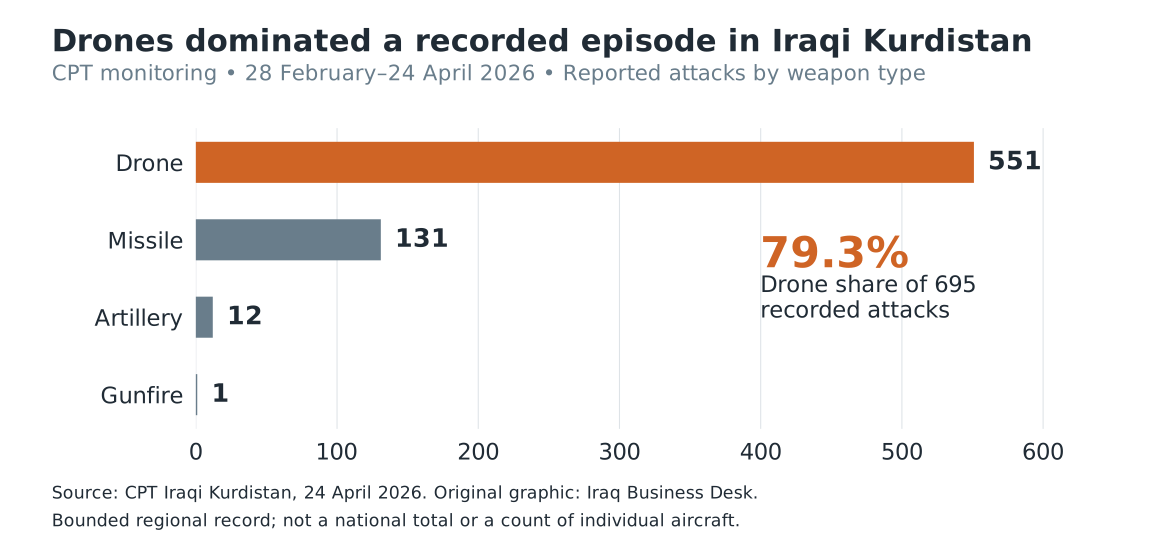
The significance is the scale of exposure within a limited period. It also illustrates why military protection cannot be confined to a distant front line. Facilities, workplaces and communities share an operating environment in which attacks on one category can interrupt the activities of another. The number alone does not establish the accuracy of the weapons, their individual launch locations or the extent of centrally coordinated planning.
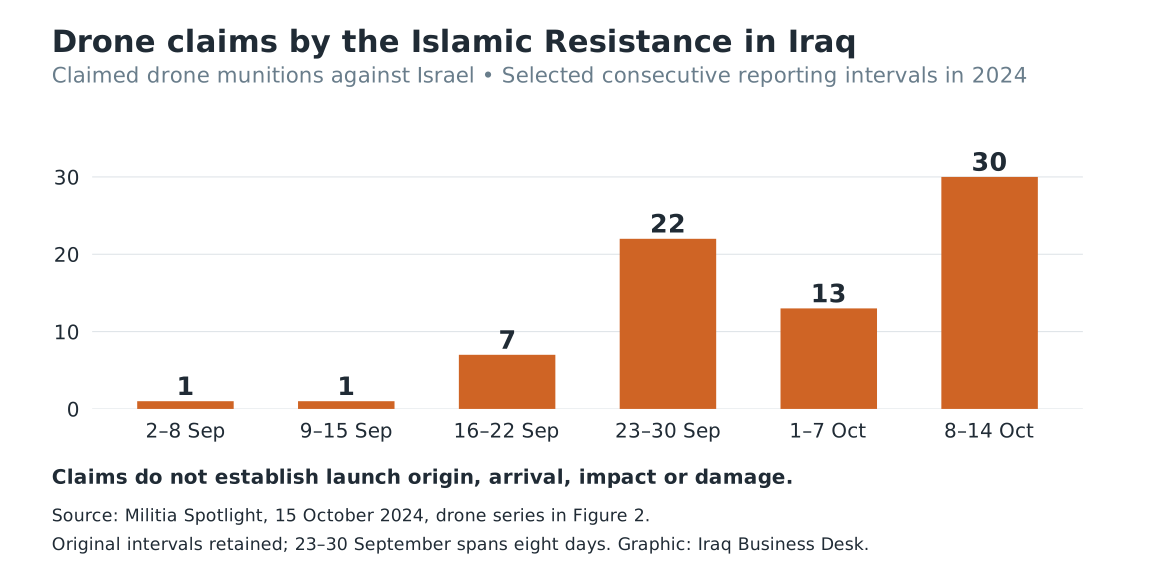
For the outward dimension, the Washington Institute's Militia Spotlight recorded drone munitions claimed by the Islamic Resistance in Iraq against Israel during 2024. Its published chart shows a marked increase across selected September and October reporting intervals. These are claims by an Iraq-based umbrella, not verified impacts or proof that every launch occurred inside Iraq. They nevertheless reveal the scale of activity the organisation sought to advertise and the regional confrontation with which it associated itself.8
Sovereignty and the cost of retaliation
For Baghdad, the problem extends beyond stopping weapons already in flight. If an organisation can initiate attacks on another state from Iraqi territory, it can expose Iraq to military and diplomatic consequences without obtaining national consent. Deniable claim brands can complicate attribution while leaving the country itself clearly exposed. Uncertainty about the perpetrators does not necessarily restrain an adversary that believes it has sufficient intelligence to retaliate.
Tower 22 provides a concise illustration of how a local strike can widen a crisis. In the early hours of 28 January 2024, a one-way attack drone struck the remote support base in northeastern Jordan, near the Iraqi and Syrian borders. Three US soldiers died. An Army account describes medical personnel responding to wounded colleagues in the aftermath. On 2 February, US forces conducted retaliatory strikes in Iraq and Syria. The US oversight report on Operation Inherent Resolve directly connects that response to the Jordan attack.9 10
The launch origin of an individual weapon and the political geography of retaliation are separate questions. An attack outside Iraq can still bring military action into Iraq. That is a practical sovereignty problem: the state must manage foreign relationships, protect its population and sustain commerce while other actors influence the timing and intensity of confrontation.
The issue became immediate again in September 2026. ABC reported Saudi statements that drones arriving from Iraq had damaged the East–West oil pipeline, prompting a precautionary closure. It also reported an Iraqi government statement confirming Iraqi origin. Riyadh said it had initially chosen restraint at Baghdad's request. Those statements establish the official accounts of origin and response; they do not identify the operational chain of command. The episode demonstrates both the exposure and the value of diplomacy in containing it.11
The Kurdistan Region's energy experience adds an economic dimension. DNO reported that drone strikes in July 2025 depressed production capacity at its Tawke licence well into the fourth quarter. That is a longer consequence than the duration of the attack itself. Security conditions can govern repair schedules, the availability of specialist personnel and the pace at which normal output returns.12
Federal and regional coordination consequently matters as much as the procurement of additional systems. Threat information, decisions to suspend operations, incident investigation and responsibilities for protection need to connect across jurisdictions. Announced purchases should be evaluated against delivered capability, trained crews, integration, maintenance and actual readiness. Iraq gains little from equipment that cannot be sustained or incorporated into a common response.
Yemen and the conversion of technology into influence
The Houthi movement offers the region's clearest sustained example of an armed organisation expanding its influence through drone and missile capability. Its development was neither an entirely indigenous technological breakthrough nor a simple sequence of deliveries from abroad. External support interacted with local institutions, assembly, experience and political ambition.
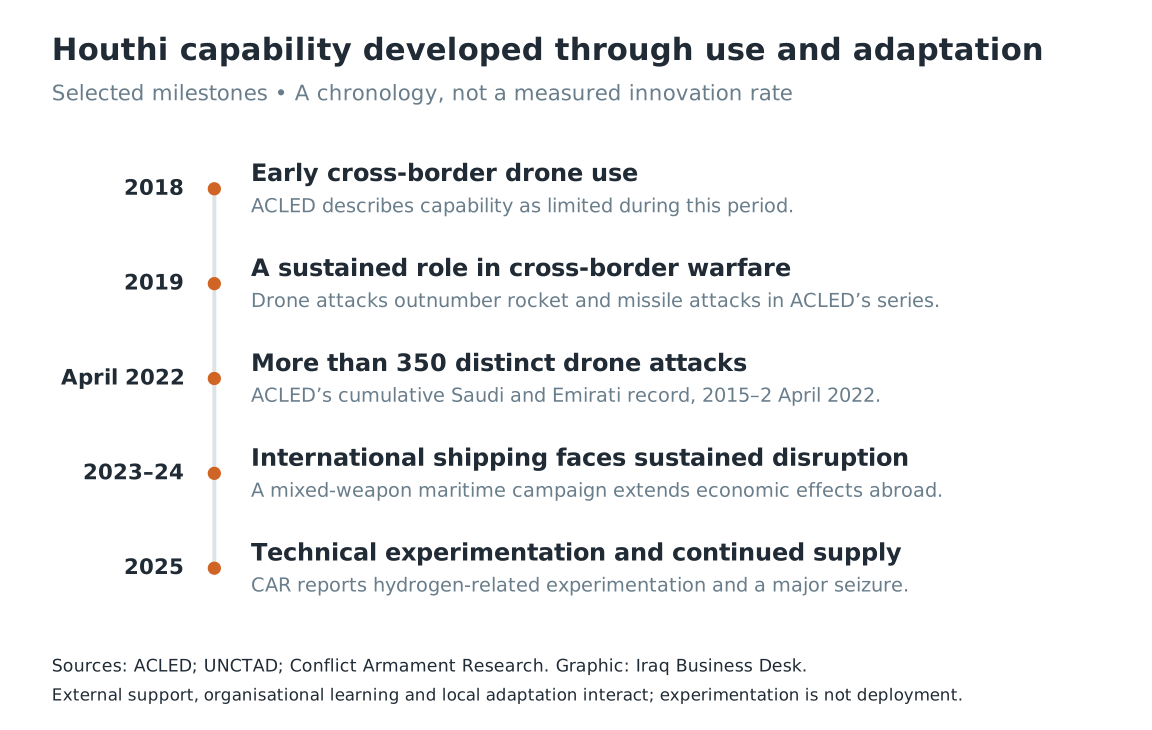
ACLED's historical study describes limited Houthi drone use in 2018 followed by expanded cross-border operations in 2019. Across its 2015–2 April 2022 record, it identified more than 350 distinct drone attacks against Saudi and Emirati territory. Drone attacks outnumbered rocket and missile attacks from 2019. The movement had acquired a repeatable means of threatening places far beyond its principal ground battlefields.13
Evidence of external supply is substantial. In July 2024, the US Defense Intelligence Agency published its analysis of weapons seized at sea, comparing recovered components with Iranian systems. It reported that the United States and partners had intercepted at least 20 Iranian smuggling vessels between 2015 and 2024. The seized materiel supports a picture of recurring external supply alongside local adaptation.16
Independent field research also describes continuing technical development. Conflict Armament Research's March 2025 dispatch reported evidence that the Houthis might be attempting to power uncrewed systems with hydrogen. That finding documents experimentation, not verified operational deployment of such systems. Its September 2025 reporting identified an extensive seizure with links to Iran-associated supply networks. These findings show why analysts must track components and technical activity alongside attacks.15
The maritime campaign exposed the strategic value of this accumulated capability. A shipowner deciding whether to send a vessel through the Red Sea must consider the consequences of a successful attack, the reliability of protection and the obligations owed to crew and cargo interests. A small number of damaging incidents can influence many voyages. Naval interceptions can protect individual ships while commercial operators still judge an entire route too uncertain.
By mid-October 2024, UNCTAD reported an average of 33 daily Suez Canal transits, 55% below the level a year earlier. The wider trade disruption involved several pressures, including problems at the Panama Canal. Even so, the Red Sea crisis demonstrated how an armed movement in Yemen could affect schedules and costs across international supply chains. The campaign involved missiles and other means alongside aerial drones; its economic effects cannot be assigned to drones alone.14
The Houthis' effectiveness should be judged against specific objectives. They demonstrated an ability to disrupt shipping and impose substantial defensive demands. That does not establish an ability to control maritime trade indefinitely or translate every military action into favourable political terms. Their operations also expose Yemen to retaliation and add to the burdens facing its population. Tactical persistence and national welfare can move in opposite directions.
For Iraq, the lesson is uncomfortable. An organisation can become regionally consequential without reproducing the institutions or equipment of a conventional air force. Contacts between the Houthis and Iraqi factions merit attention because expertise and relationships can travel. Published accounts of such ties do not establish a reliable current Houthi headcount in Iraq, or prove participation in a particular attack. The relevant intelligence questions concern demonstrated transfers, training, operational cooperation and sustainment.17
The accelerating cycle of adaptation
Drone development increasingly proceeds through repeated changes to an existing system rather than occasional replacement by a wholly new aircraft. Operational experience reveals shortcomings; engineers and operators adjust components, software or procedures; the revised system returns to use. Defenders adapt in turn. A capability that worked reliably several months earlier may become less effective without any change in its advertised specification.
Ukraine makes the compressed timescale especially visible. In their 2024 RUSI study, Justin Bronk and Jack Watling argued that maintaining effective UAV systems could require updates to software, sensors, radios and other elements every six to twelve weeks. That finding concerns the conditions they examined, not a universal timetable for every Middle Eastern force. It demonstrates the mismatch between rapid operational learning and acquisition systems organised around long replacement cycles.18
The Middle East has its own development cycle. Houthi experience shows how a recipient can move from limited use to sustained campaigns, expand the purposes for which weapons are employed and continue seeking technical improvements. Iran's relationships with multiple users create opportunities for experience to circulate. Turkey and Israel have substantial domestic industries, while Gulf states can finance imports, partnerships and local production. Each route has different dependencies.
The capabilities most worth monitoring are those that improve reliability, navigation, endurance, resistance to countermeasures and the availability of usable intelligence. Changes in assembly capacity or component supply can be as consequential as a new model displayed in a video. RUSI's analysis of Ukraine's component dependencies underlines the wider point: expanding output does not eliminate vulnerability to imported subsystems.19
Autonomy may further alter this competition, but the term needs discipline. Navigation without continuous human control, automated image processing and independent target selection are different functions. Evidence of one does not establish the others. A promotional claim about artificial intelligence should not be treated as proof of reliable combat performance. SIPRI identifies both the trend towards more autonomous systems and the accountability concerns accompanying it.3
Acceleration is also uneven. Some organisations can purchase technology faster than they can train operators or build a dependable maintenance system. Others retain experienced personnel but lack reliable supply. Political restraint may reduce attacks despite improving capability, while an intense campaign may consume stocks without generating meaningful technical advances. Intelligence assessments should therefore distinguish the speed of development, the scale of production and the pace of operations.
A regional balance with more centres of coercive power
Iran and the limits of sponsor control
Iran's importance rests partly on the combination of domestic weapons development and relationships with armed organisations abroad. Technology transfers can extend pressure beyond Iran's borders and complicate an opponent's allocation of defensive resources. The same relationships can expose partners to retaliation and make regional escalation harder to contain.
A common design, Iranian component or established political relationship does not establish who authorised an individual mission. Support, influence and operational command are different propositions. Iraqi analysis needs to preserve those distinctions because the consequences of attribution can include sanctions, retaliation and pressure on state institutions. Conversely, uncertainty should not become a reason to ignore well-supported evidence of supply and coordination.
The strategic risk is a network in which capabilities are distributed but escalation authority is unclear. Local actors have their own constituencies, rivalries and calculations. A sponsor may welcome pressure at one moment and seek restraint at another, while a partner has incentives to demonstrate independence or recover credibility. Drones expand the means available within those political relationships; they do not remove the politics.
Israel and Hezbollah
Israel demonstrates both the advantages of sophisticated defence and the continuing burden of persistent threats. In April 2024, US Central Command reported that American forces, supported by European Command destroyers, destroyed more than 80 one-way attack drones and at least six ballistic missiles associated with the attack on Israel. The statement also included weapons destroyed in Yemen before launch, so it should not be converted into an airborne interception success rate.20
The episode nevertheless shows the value of preparation, intelligence and international cooperation. It also shows how much activity can be required to defend against a major attack. That degree of support cannot simply be assumed for every Iraqi facility or every future regional crisis.
Hezbollah's experience illustrates a different problem: a non-state organisation can retain an ability to threaten and disrupt even when facing a much stronger adversary. Its drone operations must be considered alongside rockets, missiles, surveillance and ground combat. Carnegie's April 2026 analysis examines the movement's wartime calculations, reinforcing the need to distinguish military activity from the political objectives it serves.21 For Iraq, the wider implication is that weakening an organisation and eliminating its capacity to impose costs are different tasks.
Turkey and the Gulf states
Turkey represents proliferation through an established state defence industry, exports and operational experience. Its position differs from Iran's relationships with armed factions, although both can spread capability beyond national borders. SIPRI's analysis of regional arms transfers identifies Turkey's growing supplier role and the expansion of UAV acquisition across the Middle East. Such transfers can also create continuing relationships in training, maintenance and support.22
For Iraq, Turkish operations make northern airspace a setting where state aircraft, armed groups and civilian activity overlap. For the Gulf, Turkish and other foreign systems offer procurement choices and industrial partnerships. Supplier diversity can improve options but make integration and maintenance more demanding. Buying from several countries does not automatically produce a coherent defence architecture.
Saudi Arabia and the UAE combine substantial resources with extensive industrial and urban infrastructure. Kuwait, Qatar and Bahrain face their own combinations of energy concentration, foreign military presence and essential-service dependence. Jordan's geography and military relationships expose it to regional confrontation even when its priority is avoiding involvement. These countries share some threats but differ greatly in strategic depth, financial capacity and the redundancy available in their infrastructure.
Why disruption can spread so quickly
The Middle East's vulnerability arises from the intersection of concentrated assets and deeply connected services. A processing plant, export terminal or power installation can support activity far beyond its perimeter. An interruption can affect organisations that have no direct connection to the original dispute. Protection must therefore be assessed at the level of service networks as well as individual sites.
Iraq's oil dependence magnifies the fiscal consequences. The US Energy Information Administration reports that oil provided approximately 90% of government revenue in 2023. A regional price increase can support receipts if exports and payments continue, but it cannot compensate automatically for inaccessible terminals, interrupted production or higher transport costs. Actual saleable volumes and realised proceeds determine the result.23
Electricity adds a more immediate social channel. The IEA estimates that cooling accounts for nearly half of peak electricity demand across the Middle East and North Africa. Water scarcity and the region's growing use of desalination further connect reliable power with daily life. These regional figures should not be read as Iraq-specific measurements, but the underlying dependence on electricity is directly relevant to Iraqi cities and industry.24
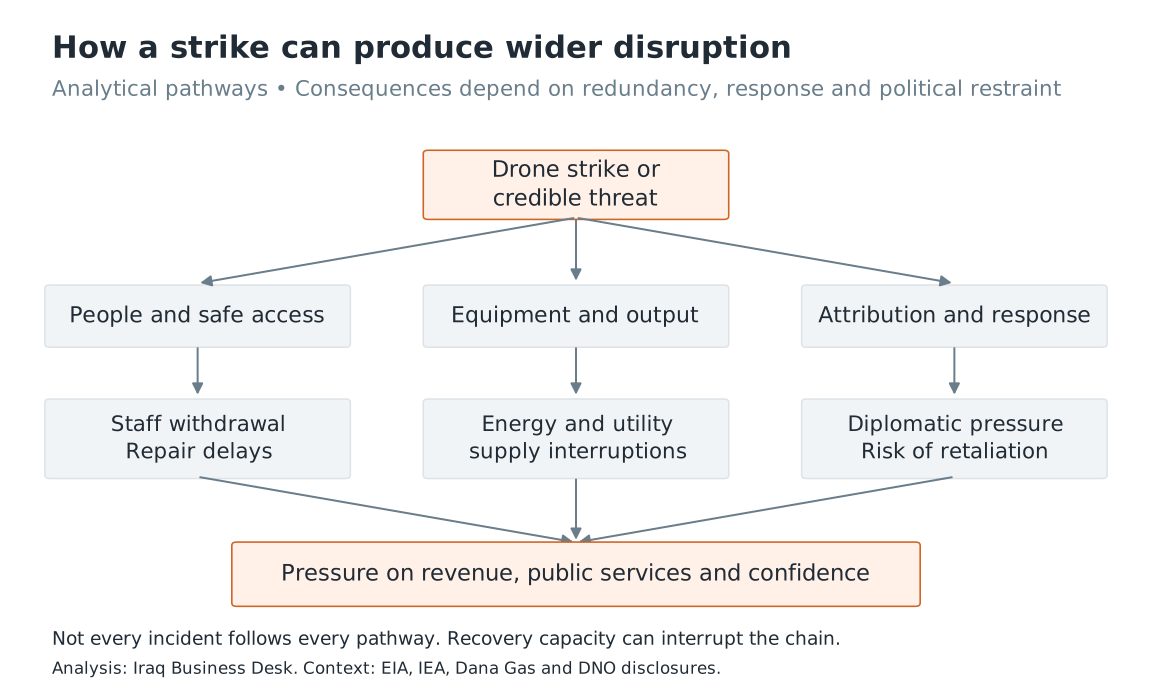
Iraq's public-service pressures can turn an outage into a test of government credibility. A prolonged interruption affects household life, commercial refrigeration, manufacturing and healthcare. Where citizens already doubt that institutions can provide reliable services, another failure can intensify resentment. That is a conditional mechanism of destabilisation, not a prediction that a drone attack will produce unrest or government collapse.
Saudi Arabia's September 2019 experience provides a useful counterweight to fatalism. Following the attacks on Abqaiq and Khurais, Aramco reported that production at Khurais resumed within 24 hours. On 17 September, it said Abqaiq was producing two million barrels a day and that inventories and output from other fields were supporting customer deliveries. Those were company statements about recovery and supply management, not evidence that the initial attack had been inconsequential.25
The lesson is that resilience changes the strategic outcome. A dramatic strike can cause serious damage without producing a prolonged interruption of national revenue. Available stocks, engineering capacity, alternative production and coordinated emergency response can limit the attacker's gains. Iraq should evaluate these capabilities alongside the probability of interception.
Large infrastructure projects make that calculation more urgent. A new gas development, refinery, port or transport corridor may strengthen the economy while concentrating additional dependence in a small number of facilities. Security requirements need to influence design, redundancy, maintainability and operating arrangements from the outset. Retrofitting protection after commissioning is often more disruptive than incorporating it during development.
Export diversification is especially important, but a new route is only useful if the wider chain works. A pipeline depends on functioning supply, terminals, shipping access and commercial arrangements. Bypassing one chokepoint can create exposure to another. Iraq's Development Road ambitions and proposed energy corridors should therefore be assessed as networks whose usefulness depends on dependable operation across several jurisdictions.
The destabilising effect can also occur without major physical destruction. Repeated alarms can delay flights, discourage specialists from travelling and make governments appear unable to enforce restraint. Ambiguous claims can accelerate rumours and pressure leaders to respond before evidence is complete. Accurate public communication becomes part of security: it can distinguish a contained incident from a wider failure and prevent exaggerated claims from determining the political narrative.
Military adaptation is an institutional task
Armed forces must prepare for drones as a routine feature of their operating environment. Treating them as occasional specialist threats leaves ordinary units dependent on improvised responses. Training needs to cover recognition, reporting, coordination and operating under sustained disruption, while commanders need a realistic understanding of what their assigned protection can and cannot do.
The US Department of Defense's December 2024 strategy explicitly connected countering unmanned systems with doctrine, organisation, training, personnel and force development. That framing is useful for Iraq because the challenge crosses institutional boundaries. It cannot be solved by assigning every responsibility to one equipment purchase or one specialist unit.26
Protecting missions and essential services
Defensive planning should begin with the missions and services that must continue. Protecting personnel, an airfield and an electricity supply chain creates different requirements. A facility's importance depends partly on the alternatives available if it stops working. A modest installation with no substitute may deserve greater attention than a larger asset with spare capacity elsewhere.
Layered defence combines detection, identification, warning and appropriate responses with measures that reduce the consequences of penetration. No single sensor or countermeasure covers every threat. Electronic measures, physical interception and protective engineering each have limitations. Their value depends on integration, local conditions, operator proficiency and the surrounding civilian environment.
Iraq should make the allocation of responsibilities explicit. Military forces, civil aviation, police, regional authorities and infrastructure operators need agreed reporting arrangements and clear authority to act. The objective is a timely, lawful response that protects civilians and avoids conflicting actions. Sharing information is difficult when organisations distrust one another or use systems that cannot exchange relevant data; those obstacles need direct institutional attention.
Learning faster without abandoning accountability
Procurement should support continuing adaptation. Contracts need credible provisions for software support, maintenance, training, testing and integration. A demonstration under favourable conditions is insufficient evidence that a system will work reliably in Iraq's heat, dust, crowded communications environment and complex airspace. Acceptance should be tied to the intended operating conditions and measurable performance.
Faster acquisition also needs safeguards against purchasing incompatible products or becoming dependent on a vendor that controls essential updates. Modular systems and accessible technical support can help, but only when the armed forces have personnel capable of evaluating them. An institution that cannot define its problem clearly is vulnerable to persuasive marketing and repeated procurement disappointments.
The feedback process should connect operators, investigators, engineers and commanders. Each significant incident should inform training and the assessment of existing protection. Evidence needs to be preserved, competing explanations tested and lessons circulated without turning every operational failure into a political accusation. That requires professional incentives for reporting weaknesses honestly.
Sustaining defence over a campaign
An interception is an event; defence is a continuing commitment. Forces need adequate crews, maintenance, replacement components and replenishment arrangements. A technically effective system can lose practical value when spare parts are unavailable or personnel cannot maintain continuous readiness. The duration of a campaign matters as much as its peak intensity.
Cost comparisons should reflect that wider commitment. An expensive interception may be justified if it protects lives or a critical service. The strategic concern is whether the defender can sustain protection across many places and repeated attacks. Evaluating cost per protected operating day, alongside casualties and service continuity, provides a more useful perspective than comparing two advertised unit prices.
Recovery should be exercised with the same seriousness as interception. Fire services, medical teams, infrastructure engineers and military personnel need rehearsed arrangements for assessment and restoration. Forces should practise operating with degraded communications and interrupted utilities. Civilian operators need reliable channels for obtaining warnings and reporting conditions without compromising sensitive military information.
Drones will also change the armed forces' own reconnaissance and operational demands. RUSI's work stresses their dependence on other force elements and on trained personnel.18 Iraq therefore needs both defensive adaptation and a disciplined approach to integrating its own unmanned systems. Building one capability while neglecting the other would leave a significant gap.
Regional cooperation can improve warning and understanding of shared threats, but its political requirements are substantial. States may hesitate to exchange information that exposes sensitive capabilities or appears to commit them to another country's conflict. Practical cooperation can begin with civilian protection, incident reporting, airspace safety and emergency coordination. Clear limits and reliable procedures are more valuable than expansive declarations unsupported by implementation.
Business risks and investment decisions
For businesses, the central exposure is the loss of dependable operating time. A company may suffer no direct damage yet lose access to electricity, a port, specialist contractors or a critical supplier. A security assessment that stops at the perimeter can therefore miss the dependencies most likely to interrupt revenue.
Management should connect threat monitoring with decisions it can actually make: when to pause work, who authorises a restart, how personnel receive warnings and which functions can continue elsewhere. Employee and contractor arrangements need to be consistent. A protection plan that covers permanent staff but overlooks maintenance teams, drivers or temporary workers leaves important exposure unresolved.
The most useful intelligence distinguishes intention, capability and observed activity. General regional alerts have limited value unless translated into implications for the company's locations and dependencies. A change in targeting, a credible threat against a sector or a deterioration in repair access may matter more than another unverified claim of a distant strike. Decisions should rely on agreed indicators and named responsibilities rather than ad hoc reactions to social media.
Insurance requires the same specificity. Property, terrorism, political violence and war cover can respond differently, and ordinary business interruption protection may require insured physical damage. Damage at a supplier, loss of access, utility failure or a precautionary shutdown may depend on separate provisions. Allianz's review emphasises that coverage follows the individual policy's terms, conditions and exclusions.27 The relevant question is how the policy responds to the company's actual scenarios.
Businesses should review covered causes, territorial scope, deductibles, waiting periods, sublimits, indemnity periods and any cancellation or notification provisions with their broker and insurer. The insured entity, assets and dependencies must be accurately described. Incident records, operational logs and evidence of loss should be preserved from the beginning. A policy cannot be evaluated solely by its headline limit.
Marsh's September 2026 analysis points to pressure on regional aggregation, insurance capacity and contingent business interruption. It also highlights the practical difficulty of assessing and repairing losses when contractors or equipment cannot reach a site.28 For an Iraqi project, that makes realistic restoration planning relevant to both financing and insurance. A replacement component's purchase price may be less important than the time required to deliver and install it safely.
Investment appraisal should include a range of interruption durations, additional protection and recovery expenditure, and the liquidity needed to survive a prolonged pause. These should be project-specific assumptions, not a generic premium applied uniformly to Iraq. Lenders and sponsors should examine whether alternative suppliers share the same vulnerable infrastructure and whether contract schedules allow for the consequences of disruption.
There is also a national competitiveness issue. Larger companies can sometimes fund redundancy, specialist intelligence and retained risk. Smaller Iraqi firms have fewer options and may face interruptions transmitted from customers or utilities. Public investment in dependable services and shared emergency capacity therefore has commercial value beyond the individual facilities directly protected.
Opportunities in protection and resilience
The strongest commercial opportunities address continuing operational needs. Detection equipment will require integration, calibration, maintenance and trained users. Infrastructure operators will need engineering assessments, dependable backup systems, restoration planning and exercises. These services create a recurring demand for competence rather than a one-time market for hardware.
Iraq has particular scope to develop local technical support. Repair, testing, systems integration, communications engineering and training can reduce dependence on specialists who may be unable to travel during a crisis. Partnerships should transfer usable skills and provide sustained support. Local assembly has limited strategic value if essential maintenance and updates remain inaccessible.
Security intelligence can become more useful through disciplined incident databases, source verification and analysis of operational consequences. Businesses and public institutions need records that distinguish drones from missiles, claims from confirmed events, and temporary shutdowns from lasting damage. That information supports procurement, insurance discussions and investment decisions. The opportunity is credible analysis connected to a decision, rather than simply a larger volume of alerts.
Defensive technology suppliers should expect demanding customers to ask for evidence of performance, compatibility and lifecycle support. Electronic and physical countermeasures require appropriate legal authority and coordination with aviation and communications regulators. Private operators should establish what they are authorised to deploy before contracting for a system. Those requirements create a role for qualified integration and advisory services.
There are related opportunities in firefighting, industrial safety, protected power supply, spare-parts logistics and damage assessment. These investments can also improve resilience to ordinary equipment failures and extreme weather. A well-designed programme should produce measurable improvements in readiness and recovery, even during periods when no attack occurs.
The commercial challenge is to avoid selling certainty that the technology cannot provide. Buyers should reward reduced disruption, reliable support and demonstrated integration. Countries should favour capabilities they can maintain and adapt. A market organised around those outcomes would contribute more to security than repeated purchases prompted by the latest alarming incident.
Three futures for Iraq and the region
The following scenarios cover the next 12–24 months from October 2026. They describe conditional paths, not statistical forecasts. Drone capability continues to spread in all three. The differences concern political restraint, institutional adaptation and the ability to contain the consequences of attacks.
Good scenario with stronger restraint and resilience
Regional tensions ease sufficiently for governments and influential armed actors to restrain campaigns. Baghdad improves coordination with the Kurdistan Regional Government and demonstrates a greater ability to prevent unauthorised armed activity. Infrastructure operators strengthen recovery arrangements, while military improvements are tested and sustained.
In this scenario, attacks do not disappear, but fewer incidents produce prolonged interruptions or cross-border retaliation. Iraq's position improves because it can offer more dependable services and a clearer relationship between national policy and armed conduct. Investors receive evidence of reduced downtime rather than promises of complete protection.
Indicators would include durable reductions in independently corroborated attacks, effective investigation of incidents, practical coordination between institutions and shorter restoration times. A fall in public claims alone would be insufficient. The scenario would weaken if new capabilities accumulated while accountability and operational readiness remained unchanged.
Middle scenario with persistent coercion
Political disputes continue to generate intermittent attacks. Armed groups retain substantial capabilities, while governments usually succeed in preventing individual crises from becoming unrestricted regional war. Defence improves unevenly, leaving some sites relatively well protected and others dependent on temporary arrangements.
Iraq experiences recurring shutdowns, interrupted travel and periodic pressure on foreign relationships. Major investment continues selectively, but projects require more contingency, redundancy and liquidity. Businesses with strong support arrangements can remain viable; smaller firms absorb costs passed through utilities, logistics and finance.
Indicators would include recurring attack clusters around political crises, repeated restoration followed by renewed disruption, and a widening gap between protected and exposed infrastructure. This is an analytically useful planning case, not a claim that it has a measured probability. It would shift towards the good scenario if restraint became institutionalised, or towards the bad scenario if retaliation repeatedly crossed additional borders.
Bad scenario with interconnected escalation
A damaging attack or series of miscalculations connects previously separable conflicts. Retaliation reaches Iraqi territory, attacks expand across infrastructure and military interests, and regional powers find it increasingly difficult to restrain partners. Several service networks experience disruption within the same period, reducing the usefulness of alternatives that would work during an isolated incident.
For Iraq, the severe risk is simultaneous pressure on revenue, electricity, transport and government authority. Repairs take longer because specialists and equipment cannot move reliably. Public frustration grows, political actors contest responsibility and foreign partners press Baghdad to take actions that are difficult to implement. The danger is cumulative institutional strain; state collapse is neither assumed nor inevitable.
Businesses face extended interruptions, tighter insurance conditions and financing delays. Gulf states also face difficult choices about protecting infrastructure, sustaining military operations and limiting further escalation. Even where facilities survive, uncertainty can keep assets underused and investment postponed.
Warning indicators would include repeated cross-border retaliation, attacks affecting multiple essential-service networks, prolonged repair delays, reduced restraint in target selection and mounting obstacles to civilian transport. The scenario would become less plausible if communication channels remained effective, restoration outpaced damage and major actors demonstrated sustained restraint after serious incidents.
The global implications and the intelligence priorities
The Middle East's experience will influence warfare elsewhere. It shows how commercially accessible technologies and state assistance can enable smaller actors to create strategic consequences. It also demonstrates that an expensive defence can be justified and still difficult to sustain across a prolonged campaign. Armed forces will increasingly be judged on their capacity to learn, replenish and recover as well as their ability to acquire advanced systems.
For the global economy, the significance lies in connected infrastructure. A regional conflict can alter shipping, energy availability and financing conditions far beyond the locations attacked. Infrastructure planners cannot assume that geographical distance from a conventional battlefield provides adequate protection. At the same time, the Saudi recovery example shows that engineering capacity and operational flexibility can sharply limit an attack's lasting effect.
Proliferation policy must address supply chains, technical knowledge and financing alongside finished weapons. SIPRI notes that existing control arrangements cover only parts of the expanding spectrum of armed unmanned systems.3 Better tracing and enforcement can increase costs and delay access, but durable restraint also depends on the political incentives of the organisations using them. The civilian functions of many components make indiscriminate restrictions economically costly and difficult to administer.
International humanitarian law continues to apply as weapons change. Drone technology does not remove obligations to distinguish civilians from military objectives, assess proportionality and take precautions. Greater automation makes reliable human responsibility and review more important. For Iraq, protecting civilians and essential services is also a strategic requirement: avoidable harm and opaque decision-making can erode the legitimacy on which effective security depends.
The most useful intelligence watchlist is therefore practical. Track demonstrated changes in capability and sustained output; distinguish attack claims from corroborated events; monitor changes in targets and political restraint; test whether defensive purchases become operational; and measure how quickly essential services recover. The absence of attacks may reflect deterrence, negotiations or a temporary pause. It should be interpreted alongside evidence of capacity and intent.
Iraq's objective should be to reduce the ability of any actor to convert a drone attack into a national crisis. That requires control over armed decisions, military institutions capable of continual adaptation and infrastructure designed to keep working under stress. The tank at Khor Mor was only one part of the problem. The larger question was whether people could safely return to work, production could resume and the state could prevent the next incident from setting the terms of national life.
Evidence and graphic methodology
Research cutoff is 5 October 2026. The article combines public company disclosures, conflict monitoring, official statements and published research with Iraq Business Desk analysis. Official and armed-group accounts are attributed; no field interviews or confidential access are implied. Scenarios and causal pathways are analytical judgments.
Figure 1 reproduces CPT's aggregate weapon classifications for its defined Kurdistan Region episode. The drone share is calculated as 551 divided by 695, rounded to 79.3%. CPT's attribution and inclusion decisions remain its own. Figure 2 transcribes six consecutive reporting intervals from the drone series in Militia Spotlight's published figure, rather than its broader mixed-weapon attack totals. Different units, territories and periods prevent direct comparison between the two graphics.
An attack event, a claimed munition, an individual aircraft and a confirmed impact are different measures. The graphics do not estimate national attack growth, launch-origin totals or interception success rates. A claim by an Iraq-based organisation does not establish a launch from Iraq. No general air-strike dataset has been relabelled as drone-only data. Figures 3 and 4 are a sourced chronology and an analytical diagram, respectively. All graphics are original presentations; underlying data and source links accompany the reusable chart files.
References and related Iraq Business Desk coverage
1. Disclosure on the 26 April 2024 Khor Mor incident — Dana Gas, 29 April 2024.
2. Directors Report 2025 — Dana Gas, March 2026.
3. Proliferation and use of missiles and armed uncrewed aerial vehicles — SIPRI Yearbook 2026; Kolja Brockmann and Ian Davis, 2026.
4. CTC publishes new report on Islamic State and drones — Combating Terrorism Center at West Point, 11 July 2018.
5. Research on drone use by militant groups in Iraq — Aldebaran Threat Consultants, 24 July 2025.
6. Standing With Iran The Integrated Combat Performance of Iraqi Militias During Operation Epic Fury — CTC Sentinel; Michael Knights, Alex Almeida and Crispin Smith, June 2026.
7. Despite the ceasefire Iran and affiliated groups continue attacks on the Kurdistan Region of Iraq — Community Peacemaker Teams Iraqi Kurdistan, 24 April 2026.
8. Tripling of Iraqi Militia Claimed Attacks on Israel in October — The Washington Institute; Michael Knights, Ameer al-Kaabi and Crispin Smith, 15 October 2024.
9. The Hometown Heroes of Tower 22 — US Army; Sgt First Class Zach Sheely, 27 March 2024.
10. Operation Inherent Resolve Quarterly Report to Congress — Lead Inspector General, 1 January–31 March 2024.
11. Saudi Arabia closes oil pipeline after drone attack launched from Iraq — ABC News, drawing on AFP, AP and Reuters, 12 September 2026.
12. Kurdistan region of Iraq — DNO, 2025 operational review, accessed 5 October 2026.
13. Beyond Riyadh Houthi Cross Border Aerial Warfare 2015 to 2022 — ACLED; Luca Nevola, Historical record through 2 April 2022.
14. Suez and Panama Canal disruptions threaten global trade and development — UN Trade and Development, October 2024.
15. Field dispatches on Houthi technical experimentation and resupply — Conflict Armament Research, March and September 2025.
16. DIA Report Showcases Iranian Origin of Houthi Weapons Interdicted at Sea — US Defense Intelligence Agency, July 2024.
17. Leverage Beyond Yemen Ansar Allah and Its Iraqi Alliances — Carnegie Endowment; Ibrahim Jalal, 25 February 2025 as displayed on the article.
18. Mass Precision Strike Designing UAV Complexes for Land Forces — RUSI; Justin Bronk and Jack Watling, 11 April 2024.
19. Drones Win Battles Components Win Wars — RUSI; Mirko Niederkofler, 17 December 2025.
20. Defense of Israel Activities Update — US Central Command, 14 April 2024.
21. Hezbollah’s Wartime Strategy — Carnegie Endowment; Mohamad Fawaz, 1 April 2026.
22. Recent trends in international arms transfers in the Middle East and North Africa — SIPRI, 2025; data period 2020–24.
23. Iraq Country Analysis Brief — US Energy Information Administration, July 2025.
24. The Future of Electricity in the Middle East and North Africa Executive summary — International Energy Agency, 2025.
25. Aramco CEO Saudi Aramco rapidly restores production capacity expects stabilization of global supply — Saudi Aramco, 17 September 2019.
26. DoD Announces Strategy for Countering Unmanned Systems — US Department of Defense, 5 December 2024.
27. Political violence and civil unrest trends 2026 — Allianz Commercial, 2026.
28. Insurance is doing what it should in the Middle East crisis but the pressure points are visible — Marsh; Andrew Herring, Accessed 5 October 2026.
Related Iraq Business Desk coverage
Iraq outlines air-defence plans as coalition mission ends — 5 October 2026; underlying Rudaw report 30 September.
ISW–Critical Threats examines claims about Iraqi drone networks — 5 October 2026; underlying assessment 14 September.
Alhurra’s report on Houthis in Iraq what remains unconfirmed — Updated 5 October 2026; underlying Alhurra report 2 October.
Houthis claim attack on Aramco facility in Riyadh Reuters reports — 5 October 2026; underlying Reuters report 3 October.
Saudi coalition reports intercepting four drones and two missiles — 5 October 2026; underlying Arab News report 1 October.
Tanker reports nearby explosions south of Bab el-Mandeb — 5 October 2026; underlying Maritime Executive report 4 October.
Beyond Hormuz what Saudi and Iraqi oil routes can deliver — Updated 5 October 2026.